The Cognitive Pathway
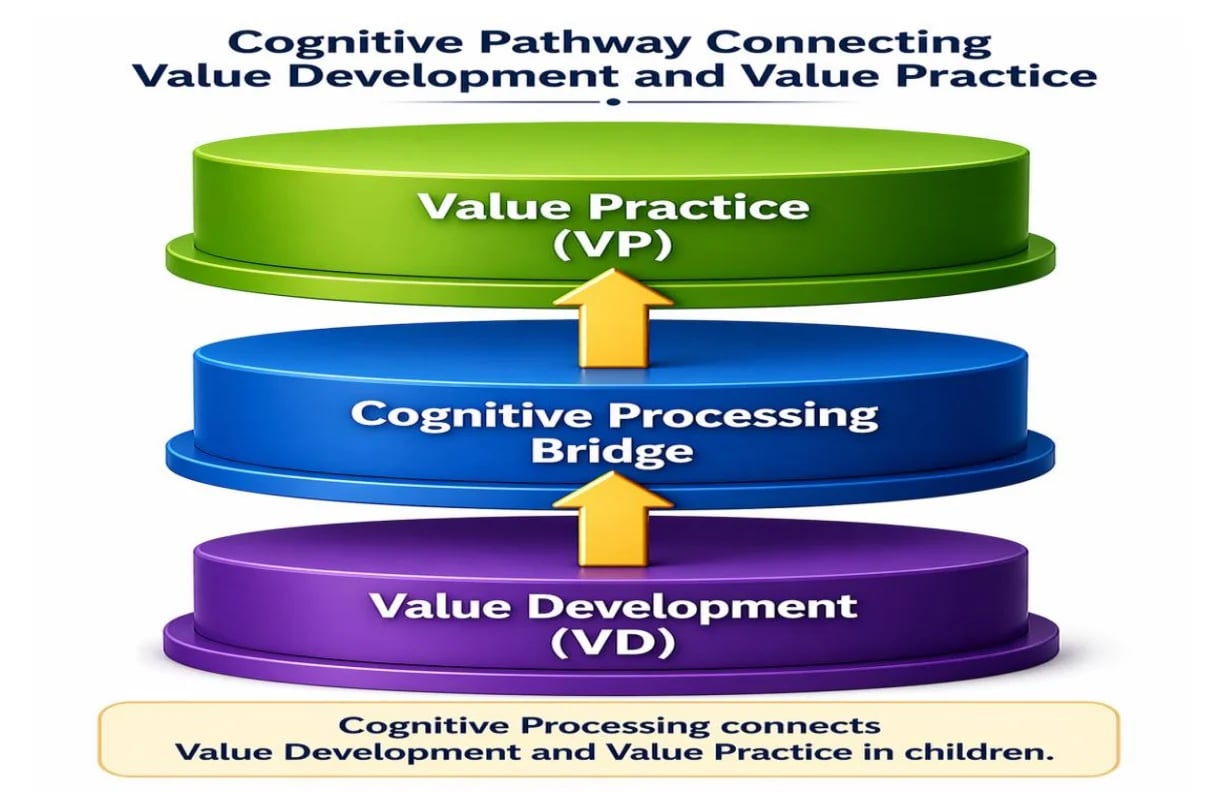
Value Development and Value Practice — interconnected through cognitive processing
Cognition refers to the mental processes through which children notice, understand, interpret, remember, think about, and respond to situations around them.
These processes help children make sense of their experiences, participate in social situations, and guide their behaviour in everyday life.
How mental processes support children's understanding and participation in everyday life
| Cognitive Process | Role in Children's Lives | Example |
|---|---|---|
| Attention | Helps children notice important features in situations | A child listens carefully to instructions before starting a task |
| Perception | Helps children interpret what they see, hear, and experience | A child recognises that a classmate is upset by observing facial expressions |
| Memory | Helps children recall past experiences and apply them in new situations | A child remembers classroom rules and follows them independently |
| Thinking & Reasoning | Help children understand situations and consider appropriate responses | A child realises that sharing materials helps group work continue smoothly |
| Decision Making | Helps children choose how to act in different situations | A child decides to wait for their turn instead of interrupting |
| Problem Solving | Helps children find alternative ways when difficulties arise | A child tries another method when the first attempt at solving a task does not work |
Helps children notice important features in situations
Listens carefully to instructions before starting a task
Helps children interpret what they see, hear, and experience
Recognises a classmate is upset by observing facial expressions
Helps children recall past experiences and apply them
Remembers classroom rules and follows them independently
Help children understand situations and consider responses
Realises sharing materials helps group work continue
Helps children choose how to act in different situations
Decides to wait for their turn instead of interrupting
Helps children find alternative ways when difficulties arise
Tries another method when first attempt does not work
Through these cognitive processes, children gradually develop understanding, regulate their behaviour, and participate more effectively in social and learning environments.
Cognition supports value development by helping children notice situations, understand their meaning, and recognise when values such as fairness, cooperation, responsibility, and self-control are involved. Through these processes, children gradually become aware of values and learn to interpret situations in value-related ways.
Cognition helps children:
Notice situations that involve fairness, responsibility, or cooperation
Recognise others' needs, feelings, and expectations
Understand what is happening in a situation
Recall rules, experiences, and guidance from earlier situations
Think about what may be right or appropriate in context
Cognition supports value practice by helping children think about possible responses, make appropriate decisions, and act according to values in real-life situations. It enables children to apply what they understand about values while interacting with others.
Cognition helps children:
Compare different ways of responding in a situation
Choose responses guided by fairness, cooperation, or responsibility
Control impulsive reactions when situations are difficult
Act according to expected norms in group settings
Reflect on their actions and improve future responses
The Cognitive Pathway
Value Development and Value Practice — interconnected through cognitive processing
Helps children notice and understand situations that involve values
Enables children to recognise values such as fairness, cooperation, responsibility, and self-control
Supports children in choosing responses guided by values in real-life situations
Support children in interpreting situations and thinking about appropriate responses
Connect value understanding with value-based action
Value Development and Value Practice are interconnected processes supported through children's thinking — and the Rise India Story-Time Value Education Program is designed to create structured contexts where cognition and values work together.
Value Awareness
Cognitive Processing
Value Practice