From Value Awareness to Action
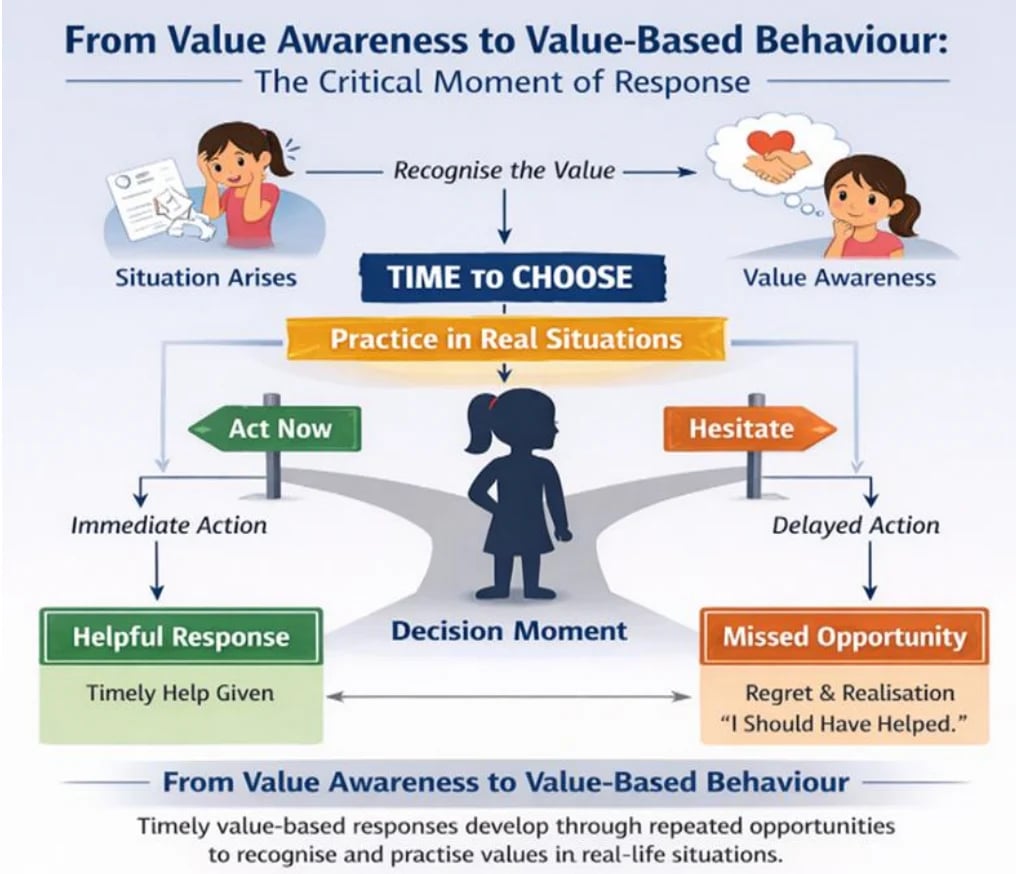
The pathway from recognising values to responding in real situations
Everyday social situations are the situations children experience while living and interacting with others in their daily life. These can be understood through simple examples:
Interactions with people
Relating with parents, siblings, teachers, classmates, friends, neighbours, and others.
Participation in shared activities
Sharing materials, working in groups, playing together, and waiting for one's turn.
Following rules and responsibilities
Listening to instructions, completing tasks, respecting classroom norms, and caring for common property.
Responding to others' needs and differences
Helping someone in difficulty, accepting differences, adjusting during disagreements, and showing patience and cooperation.
Such everyday situations naturally provide opportunities for children to learn how to respond appropriately in social settings.
How children begin to recognise values through everyday relationships
Children begin to develop awareness of values through their interactions with people such as parents, grandparents, siblings, teachers, classmates, friends, neighbours, helpers, and other members of the community.
In these interactions, children observe how people speak, behave, respond, cooperate, help, guide, correct, and relate to one another using values such as respect, fairness, care, and responsibility.
Such repeated interactions form the basis for children becoming aware of values expressed in people's behaviour in everyday life.
As children participate in everyday social situations, they gradually begin to recognise that different situations require different kinds of responses. For example:
When children start noticing what a situation expects from them and respond accordingly, they develop awareness of values in action. This growing recognition supports the development of value-based behaviour in daily life.
Value Awareness and Behaviour in Daily Life
| Everyday Situation | Value Required | Behaviour Expected |
|---|---|---|
| A classmate forgets a pen before an exam | Sharing | Offer extra stationery |
| Waiting in line for water, lunch, or bus | Patience | Wait for one's turn calmly |
| Someone is new to the class | Inclusion | Invite them into the group |
| A friend is upset or worried | Empathy | Listen and support |
| Borrowing a book from a friend | Responsibility | Return it properly and on time |
| Teacher is explaining a lesson | Respect | Listen attentively |
| Working in a group activity | Cooperation | Share roles and support others |
| Playground disagreement | Self-control | Avoid fighting, discuss calmly |
| Seeing litter in classroom | Care for environment | Pick up or dispose properly |
| Younger students need help | Kindness | Guide or assist them |
| Someone makes a mistake | Tolerance | Avoid teasing or blaming |
| School property is damaged | Responsibility | Inform teacher honestly |
| Parents ask for help at home | Duty | Support willingly |
| Elderly neighbour needs assistance | Service-mindedness | Offer help respectfully |
| Friend forgets homework | Support | Encourage instead of mocking |
| During discussion time | Respect for others | Allow others to speak |
| Sharing classroom materials | Cooperation | Use resources jointly |
| Losing a game | Sportsmanship | Accept results gracefully |
| Winning a competition | Humility | Appreciate others |
| Seeing someone left out | Sensitivity | Include them in activities |
A classmate forgets a pen before an exam
Offer extra stationery
Waiting in line for water, lunch, or bus
Wait for one's turn calmly
Someone is new to the class
Invite them into the group
A friend is upset or worried
Listen and support
Borrowing a book from a friend
Return it properly and on time
Working in a group activity
Share roles and support others
Seeing someone left out
Include them in activities
Case Illustration
A group of college-going girls travelled together to an examination centre. After reaching the venue, they began discussing last-minute concepts before entering the examination hall.
At that moment, one student suddenly realised that she had left her pen–pencil box in the vehicle they had used to travel. She became anxious because the examination was about to begin.
Another student in the group was carrying an extra pen–pencil box. Although she was aware of her friend's difficulty, she did not immediately offer to share it.
The distressed student hurried to the examination office, could not obtain help there, rushed to a nearby shop, purchased the required items, and returned just in time for the examination.
Later, while returning, the friend who had the extra box apologised for not offering help earlier. By then, the situation had already passed.
This incident shows that awareness of values does not always lead to value-based behaviour at the required moment. The student recognised the importance of helping her friend, but this recognition occurred only after the situation had passed — highlighting the gap between knowing a value and responding through it within a real situation.
From Value Awareness to Action
The pathway from recognising values to responding in real situations
When children repeatedly respond to everyday social situations with value awareness, their responses gradually become more consistent and stable.
Over time, these repeated responses develop into value-based behavioural patterns that guide children's participation at home, in school, and in the community.
As value-based behavioural responses become consistent across different situations, they gradually contribute to the development of character and personality.
When children repeatedly practise behaviours such as respect, responsibility, cooperation, honesty, and care for others, these responses begin to influence how they think, relate to people, and act in everyday life.
Over time, such patterns support the development of socially responsible behaviour and help shape a balanced and dependable personality.
Is designed to create structured situations in which children can practise values in everyday social contexts — supporting the transition from value awareness to value-based behaviour that shapes character over time.
Value Awareness
Value Behaviour
Character & Personality