Rise India – Story-Time Value Education Program

The Knowing-Doing Gap
Children often understand what is right or appropriate in a situation, but they may not act on it immediately. Knowing a value is not enough.

Children must recognise that the situation requires that value, feel ready to respond, have confidence to act, and have opportunities to practise — creating a gap between knowing a value and using it in action.

Understanding the Gap

Knowing a Value

Knowing a value is mainly a cognitive process. Children can say what should be done.

Practising a Value

Practising a value is a behavioural process. It depends on recognising the situation at the right moment and responding appropriately in real interaction contexts.

Why the Gap Exists

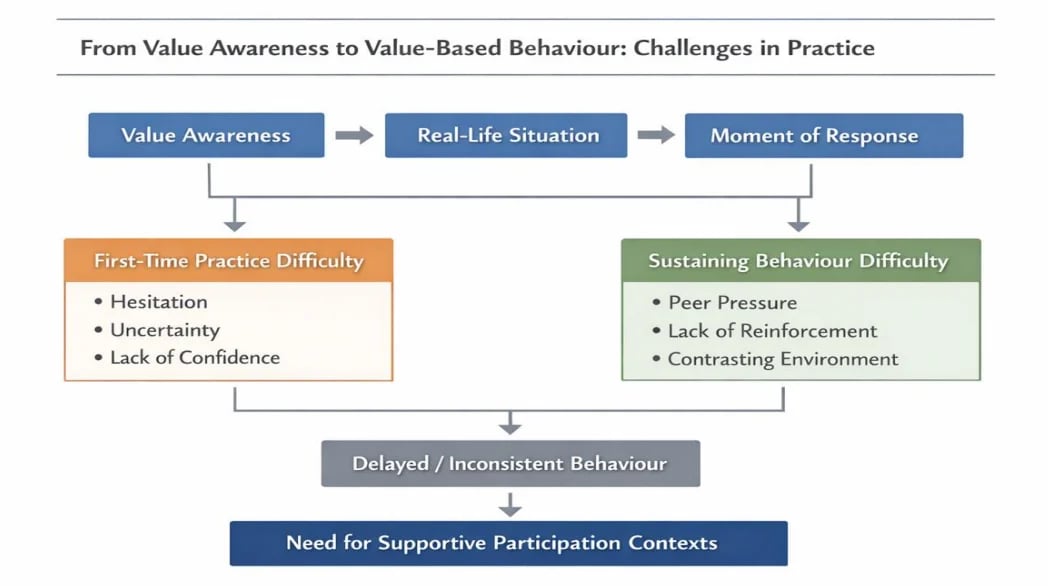
The movement from value awareness to value-based behaviour is not always immediate. Children may face different kinds of practice difficulties — especially during first attempts and while sustaining behaviour over time. These challenges show why children need supportive participation contexts and repeated opportunities to practise values in everyday situations.

Research Foundation

Research in moral development, social learning, and social–emotional learning shows that children may understand values conceptually but require guided participation and repeated opportunities to recognise situations and practise appropriate responses before those values become part of behaviour.

Sources: Jean Piaget (1932); Lev Vygotsky (1978); Albert Bandura (1977); Lawrence Kohlberg (1984); CASEL (2020); UNESCO (2015)

Case Illustration

Value Practice Difficulty in a New Peer Environment

RI–ST–VE Program · Grade IX · New School Environment
1

The Setting

An adolescent boy in Grade IX was admitted to a new school after his father's transfer. In his previous school, he had developed habits such as speaking truthfully, accepting responsibility for mistakes, and being willing to face consequences for his actions.

2

The New Peer Environment

After joining the new school, he befriended a group of five boys who frequently engaged in teasing and bullying other students, avoided co-curricular activities, and often told lies to escape responsibility.

Initially, he attempted to influence his friends positively — encouraging truthful behaviour and discouraging bullying. However, his efforts were not accepted by the group.

3

The Gap Emerges

Gradually, he found it difficult to continue practising the values he had previously followed with confidence. He experienced hesitation in maintaining truthful and responsible behaviour within the new peer setting, and began to feel a clear gap between his own value orientation and the behaviour patterns of his new friends.

The Knowing-Doing Gap

Flowchart showing progression from value awareness to value-based behavior, highlighting practice difficulties and the need for supportive contexts

The following illustration shows how factors such as peer pressure, lack of acceptance, hesitation, and reduced confidence can create a gap between a student's value awareness and his ability to practise and sustain those values in a new social setting.

From value awareness to value-based behaviour — the role of supportive contexts

Interpretation of the Situation

The student in this situation did not lack value awareness. He had already developed habits such as truthful and responsible behaviour. However, he found it difficult to continue practising these values within a peer group that followed different behaviour patterns.

This situation illustrates that children may experience difficulty both when practising a value for the first time and when sustaining previously learned value-based behaviour across changing social environments.

Continued participation opportunities therefore play an important role in strengthening value-based behaviour during development.

Value Education Insight

This example highlights an important principle of value development: values are strengthened when supported by a value-congruent environment.

Children struggle to practise values when they encounter contrasting behavioural expectations from people or situations in new environments. Supportive participation contexts are therefore essential to bridging the knowing-doing gap.

The Rise India Story-Time Value Education Program

Is designed to create structured, value-congruent participation contexts in which children can recognise situations, practise appropriate responses, and gradually bridge the gap between knowing a value and acting through it consistently.

Knowing a Value

Recognising the Situation

Acting Through It