Emotions Supporting Value-Based Behaviour
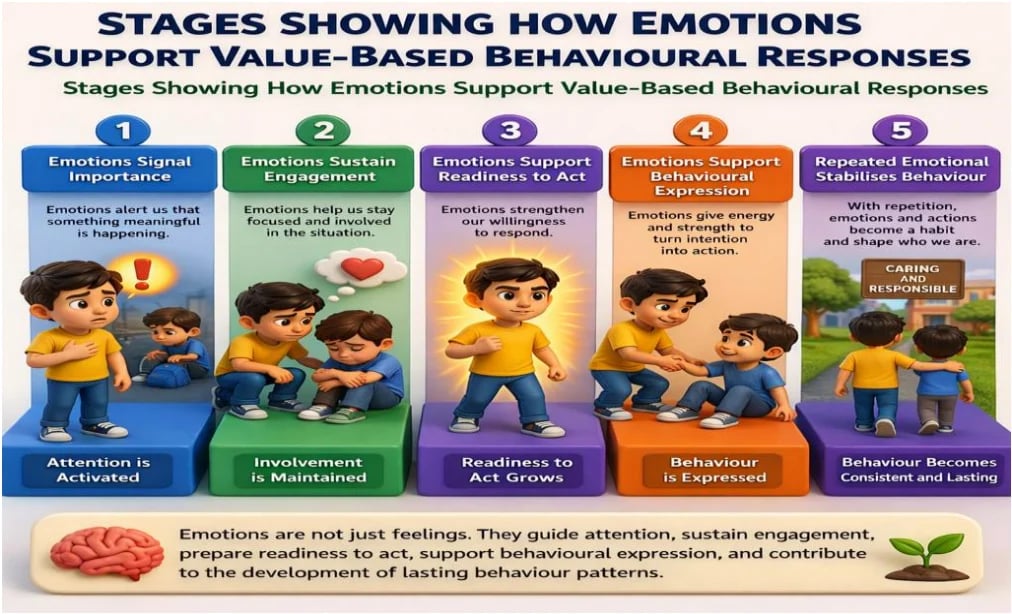
How emotions progressively support the development of value-based behavioural responses in children
Emotions develop gradually in children as part of their overall growth — from early responses linked to comfort and security, to increasingly recognising others' feelings and managing their own reactions.
Through repeated social experiences, emotions gradually become connected with emerging roles and responsibilities, contributing to the development of socially appropriate and value-guided behaviour over time.
Children are naturally emotional, and emotions play an important role in their overall development. They influence behaviour, relationships, value formation, character building, and the development of a positive and balanced personality.
In everyday life, emotions help children:
Refers to the typical manner in which a person responds to situations over time. It shows patterns in how a person usually responds in different situations.
Example: being cooperative, aggressive, responsible, or helpful.
A person's immediate action in a particular situation. It is situation-specific and may later become part of behaviour if repeated.
Example: sharing a book when a friend needs it, refusing to help, telling the truth in one incident.
Actions that are guided by internalised values such as fairness, care, honesty, responsibility, and cooperation rather than by immediate emotional reactions or external influences. Such responses develop when children understand a situation, relate it to values, and consciously choose how to respond in a value-guided and responsible way.
Emotions play a supportive role in value-based behavioural responses by helping children notice situations that require attention and remain engaged with them. They create readiness to respond when others are affected and help sustain involvement until a value-guided response can be made.
However, emotions alone do not determine how children respond. Cognitive understanding helps children interpret the situation, and value-based decisions guide the choice of action.
Through this process, emotions support the development of behaviour that becomes aligned with values over time.
Emotions
Notice & engage
Cognition
Interpret situations
Values
Guide the response
Value Behaviour
Aligned over time
Emotions Supporting Value-Based Behaviour
How emotions progressively support the development of value-based behavioural responses in children
Absence of Value Practice Leading to Negative Emotions-Driven Behavioural Responses
During their childhood years in the royal household and training under Dronacharya, the princes of the Pandavas and Kauravas regularly played and practised martial skills together. Among them, Bhima often displayed exceptional physical strength during games, sometimes overpowering the other princes unintentionally.
These repeated experiences created feelings of jealousy and insecurity in Duryodhana. He did not practise values such as fairness, cooperation, and self-control — which help regulate negative emotions and their expression — unlike the Pandavas.
As a result, his emotional reactions gradually developed into resentment toward Bhima.
On one occasion, during a riverside outing, Duryodhana secretly mixed poison into food, offered it to Bhima, and later had him thrown into the river while he was unconscious.
This incident illustrates how emotional responses, when not supported by value awareness and practice, can move toward harmful behavioural expression rather than contributing to the development of responsible and value-oriented behaviour.
Identifying the Role of Emotions in Behavioural Responses — reflect on the following questions:
Unlike Duryodhana, how should one respond in situations of competition or difficulty?
What can children learn from this incident?
List four values that could have helped regulate Duryodhana's negative emotional outbursts.
Is designed to create structured opportunities for children to recognise their emotional responses, connect them to values, and develop value-guided behaviour that replaces reactive, emotion-driven responses over time.
Emotion
Value Awareness
Value Behaviour