The Value Journey
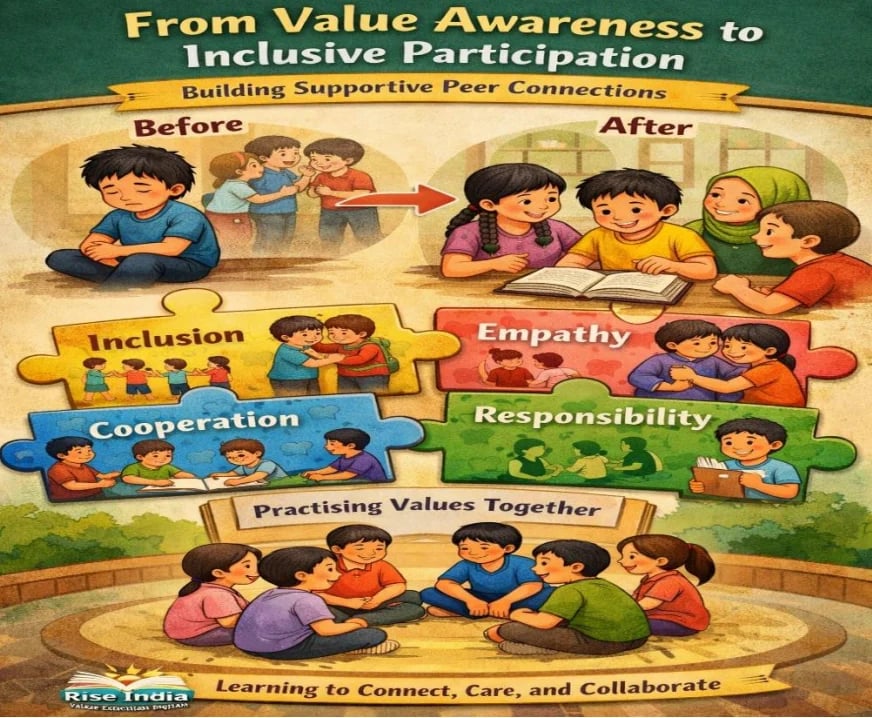
From value awareness to inclusive peer participation
Knowing values enables children to recognise what is appropriate in a situation, while responding to real-life situations reflects their ability to translate that understanding into behaviour during interaction with peers, teachers, family, and community members.
Together, they indicate the movement from value awareness to value-guided participation.
Children who differ in learning pace, behaviour, or participation style may experience reduced opportunities for meaningful peer engagement.
When classmates are not guided to understand individual differences, these situations may result in:
Source: UNESCO Global Education Monitoring Report: Inclusion and Education – All means all, 2020
Value Awareness Influencing Peer Response
In a private school implementing the Rise India – Story-Time Value Education (RI–ST–VE) Program, a Grade VII class included a student identified as a slow learner with ADHD characteristics.
When the class began participating in six-member Story-Time Value Education groups, the student was initially not accepted — not given opportunities to participate, excluded from discussions, and not assigned meaningful responsibilities.
During the first month of Phase II, students were expected to practise human values meant to guide their participation within the group.
As they engaged in practising these values, they began to reflect on how their behaviour influenced group functioning. Gradually, they started recognising the importance of applying these values in their interactions with all members.
According to the class teacher's observation, a gradual shift became visible as group members began consciously identifying which values they needed to practise in order to involve this student meaningfully in their group activities.
The Value Journey
From value awareness to inclusive peer participation
| Situation | Earlier | Value Understood | Behavioural Change Observed |
|---|---|---|---|
| Student ignored during discussion | Excluded | Inclusion | Group invited him to share ideas |
| Not given turns to participate | Overlooked | Respect | Members began giving him speaking opportunities |
| Seen as a disturbance | Avoided | Patience | Students waited while he expressed himself |
| Avoided during group tasks | Excluded | Responsibility | Members assigned him manageable roles |
| Social distance maintained | Isolated | Cooperation | Students started working alongside him |
Student ignored during discussion
Group invited him to share ideas
Not given turns to participate
Members began giving him speaking opportunities
Seen as a disturbance
Students waited while he expressed himself
Avoided during group tasks
Members assigned him manageable roles
Social distance maintained
Students started working alongside him
This shift did not occur through instruction — rather it emerged through value recognition within the peer-learning structure.
When students begin to understand the meaning of values in relation to their participation within a group, their responses to peers can gradually change in supportive and inclusive ways.
Such shifts emerge through opportunities to recognise and practise values within shared learning contexts.
Is designed to create structured situations in which this transition from value awareness to participation-guiding behaviour can take place — fostering inclusive, value-guided peer engagement in every classroom.
Value Awareness
Value Recognition
Guided Participation