The Value Process

Value Awareness → Value Decision Making → Value Practice
Decision making is an important part of children's daily life. Growing children make decisions in several ways, depending on their age, experience, and the situation.
With maturity, decisions can become guided by internal values such as fairness, honesty, responsibility, and care — moving from knowing what is right to doing what is right.
Imitation-based
Copying parents, teachers, or peers
Instruction-based
Following rules or directions from adults
Habit-based
Acting according to routines formed through repeated practice
Emotion-based
Guided by feelings such as liking, fear, sympathy, or excitement
Reward-oriented
Based on expected rewards, praise, or approval
Avoidance-based
Acting to avoid punishment, criticism, or embarrassment
Peer-influenced
Shaped by group expectations or desire for acceptance
Situation-based practical
Responding to what seems easiest or most suitable at the moment
Reasoning-based
Older children begin thinking about consequences before acting
Value-guided
Decisions guided by internal beliefs such as fairness, honesty, responsibility, or care for others
Values play a central role in decision making because they function as internal guiding principles that influence how children interpret situations, evaluate alternatives, and select appropriate courses of action.
Value-based decision making gradually develops in children as an important life skill through repeated opportunities to think about situations, consider what is right or responsible, and act accordingly.
As this ability strengthens over time, it contributes to the development of stable behavioural patterns that support character formation. When practised consistently across situations, value-guided decisions become part of children's personality and influence how they respond to people, responsibilities, and challenges in everyday life.
How value-guided decisions differ from situational compliance
When a child receives extra change from a shop, they may return it simply because a parent is watching, because they were instructed not to keep it, or because others nearby are doing the same. The action reflects a situational choice influenced by external factors.
At a later stage, the child returns the extra change because of an internal decision based on the belief that keeping money that does not belong to them is wrong. Here, behaviour is guided by value awareness and internalised principles — translating understanding into doing, that is, into value practice rather than situational compliance.
A step-by-step illustration of the process
Children gradually learn to move from knowing a value to acting according to it through everyday decision-making situations. When they recognise what is appropriate and choose how to respond in real interactions, value awareness begins to develop into value-based action.
A child in class notices that a classmate has dropped a pencil and has not seen it fall.
The child already knows that helping others is a good value.
At that moment, the child thinks whether to ignore it or return the pencil. The child decides that returning it is the right thing to do.
The child picks up the pencil and gives it back to the classmate.
The Value Process
Value Awareness → Value Decision Making → Value Practice
School Learning Environment Influencing Value-Based Decision Making
While working as a primary teacher in a reputed educational institution about three decades ago, under the guidance of a mature and thoughtful principal, a school fete was organised for students of Grades I–VII with a clear value-learning objective.
Food and beverage stalls were arranged without attendants, and students were encouraged to make purchases independently, without parental presence or guidance. They were expected to select items of their choice and place the appropriate amount of money in boxes kept near each stall.
It was observed that almost all students tendered the exact amount, thereby demonstrating honesty and self-regulation through their independent choices.
The school learning environment thus provided an opportunity for children to translate value awareness into behaviour, showing how thoughtfully designed institutional experiences support the development of moral responsibility and independent decision making.
School Fete Illustration
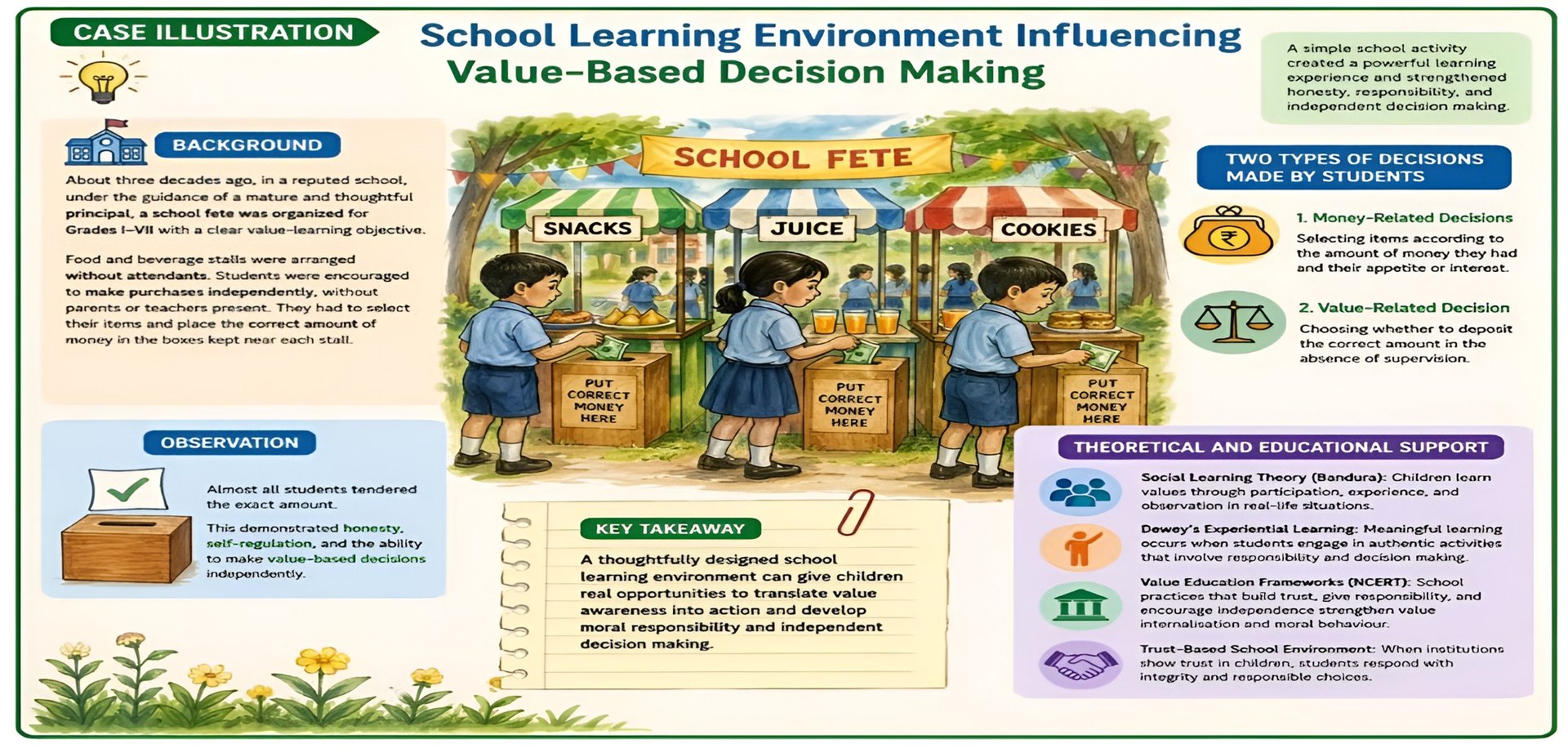
How a thoughtfully designed school environment supports value-based decision making
Role of School Environments in Value-Based Decision Making
| S.No. | Scholar / Framework | Key Idea | Implication for School-Based Value Decision Making |
|---|---|---|---|
| 1 | Lawrence Kohlberg – Just Community Schools | Moral reasoning develops through participation in real-life ethical decision situations within school settings | Structured responsibility situations in schools strengthen ethical judgment |
| 2 | James Rest – Four-Component Model | Moral action depends on sensitivity, judgment, motivation, and character shaped through situational engagement | School contexts provide opportunities to practise moral judgment |
| 3 | NCERT – Education for Values in Schools (2012) | Values are learned through participation in school practices rather than instruction alone | Institutional activities create opportunities for value-guided choices |
| 4 | CASEL – Responsible Decision-Making | Responsible decision making develops through supportive school climate and structured practice opportunities | Schools function as practice settings for ethical and responsible choices |
Moral reasoning develops through real-life ethical decision situations
Structured responsibility situations strengthen ethical judgment
Moral action depends on sensitivity, judgment, motivation, and character
School contexts provide opportunities to practise moral judgment
Values are learned through participation in school practices
Institutional activities create opportunities for value-guided choices
Responsible decision making develops through supportive school climate
Schools function as practice settings for ethical choices
As you think about the school or learning environment around you, reflect on these questions:
Identify situations in the school environment where children get opportunities to make value-based decisions.
Notice situations where students act without direct supervision but are expected to behave responsibly.
Think about school practices that encourage students to make honest and responsible choices.
Is designed to create structured participation contexts in which children can practise value-based decision making — supporting the journey from value awareness to value-guided action in everyday situations.
Value Awareness
Value Decision
Value Practice