RISE INDIA PROGRAM

RiseIndia Value Education Program

Building Values That Shape How Children Think, Learn, and Grow

Value Education helps children understand how to respond to everyday situations involving relationships, competition, and self-worth.

At RiseIndia, we focus on developing values not as rules, but as ways of understanding—enabling children to build confidence, empathy, and a growth-oriented mindset through real-life experiences.

Understanding the Context

Where Values Begin

During a group activity in class, the teacher asked the children to work together to complete a simple task. Some children began discussing how to do it, sharing materials and taking suggestions from one another, and the activity moved forward smoothly.

A few others, however, were not included in the discussion. One child kept the materials to himself and refused to pass them on. Another insisted that the task should be done only his way. Soon, disagreement arose, voices grew louder, and the group stopped working.
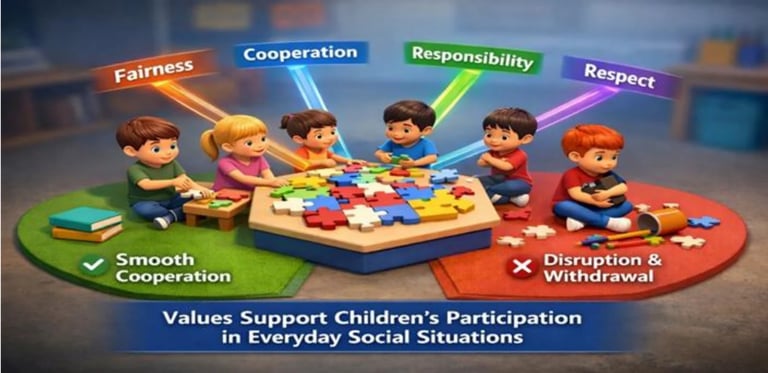
Illustrated children gathered around a puzzle table with colored labels showing core values: Fairness, Cooperation, Responsibility, and Respect supporting positive participation, versus Disruption and Withdrawal.
Real Classroom
Situations
Understanding the Need

Why This Matters

You may have observed similar situations at home, in classrooms, or during play, where children are expected to participate together in shared tasks.

In many such instances, the ability to complete an activity does not depend only on understanding the task, but also on how children relate to one another while participating.

Therefore, helping children recognise moral and human values in everyday interactions becomes an important part of their development.

The Foundation

What is Value Education?

Introducing children to such value-linked ways of responding may extend from everyday situations at home and school to other social contexts and interactions, making it an ongoing engagement.

Value Education and its incorporation may therefore be undertaken in a child-friendly and child-oriented manner.

Building Understanding

What Do We Mean by "Values"?

Jealousy
Appreciation
Competition
Cooperation
Status Protection
Self-Improvement
Comparison
Self-Growth
Isolation
Collaboration
Fixed Mindset
Growth Mindset

Values influence how children interpret everyday situations involving comparison, achievement, relationships, and self-worth.

Real Situation

Understanding Values Through Real Situations

The Case Study

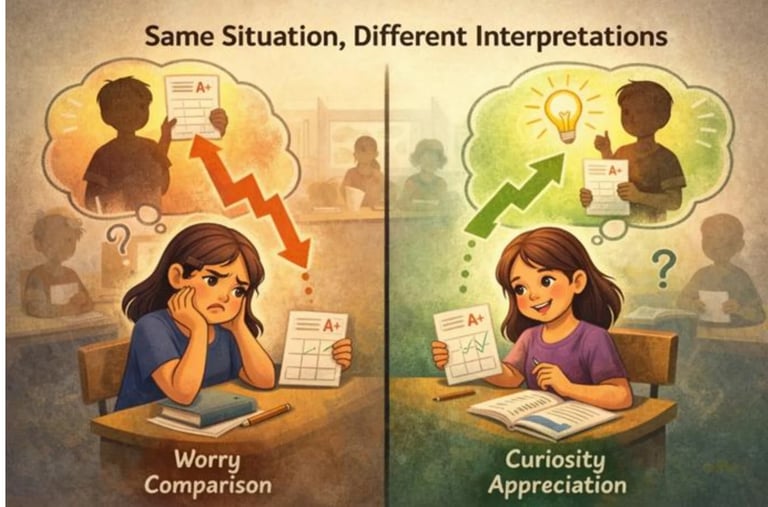
During an interaction with parents, a concern was raised about a Grade IX student who had consistently secured first rank. When a new student joined and began scoring higher marks, the child became:

Emotionally disturbed
Unable to accept change in rank
Jealous of the new student's performance
Reluctant to recognise strengths of peer
Illustration showing two contrasting mindsets: left side depicts worry and comparison with declining graph, right side shows curiosity and appreciation with rising graph and lightbulb idea

Two mindsets: Worry & Comparison vs. Curiosity & Appreciation

Key Insight

Although the concern appeared academic, the underlying issue was related to value orientation.

The Solution

Value-Based Guidance

The guidance offered to the parent focused on helping the child reinterpret the situation from a developmental perspective rather than a comparison-based perspective:

1

The presence of someone stronger can become an opportunity for improvement

2

Another student's achievement can help raise one's own learning standards

3

Instead of feeling threatened, view it as a chance to grow

4

Shift from remaining first in rank to strengthening performance

5

Accepting others' strengths increases confidence and self-improvement

6

Befriending the new classmate and observing her methods supports learning

This situation illustrates how values influence the way students interpret everyday experiences:

Area
Value-Based Shift Encouraged
View of competition
From threat To opportunity
View of peers
From rivals To learning partners
View of success
From rank position To self-development
View of strengths
From comparison To growth
Emotional response
From jealousy To appreciation
Learning orientation
From protection of status To improvement mindset

Values therefore are not merely moral rules to be followed.

They are ways of understanding situations that shape how children respond to achievement, comparison, relationships, and challenges in everyday life.

Values are not merely moral rules to be followed.

They are ways of understanding situations that shape how children respond to achievement, comparison, relationships, and challenges in everyday life.

Our Philosophy

Our Approach

The Rise India – Story-Time Value Education Program views values as interpretive orientations that influence how children understand situations involving competition, cooperation, success, and relationships.

When children gradually learn to:

Recognise strengths in others

Regulate comparison-based reactions

Respond constructively to challenges

Values begin to support both learning and personal growth.

Looking Forward

The Bigger Vision

Values do not operate only as instructions about what is right or wrong.

They influence how children interpret situations and respond to experiences in everyday life.